Thursday, December 28, 2017

Otriring

Otriring ruin
Otriring is a vast cavern network near the center of Huzar-Arân. In the God Era, Set created the Khazarkar race and sequestered them in this area. He used life energy and powerful magic to bring the Underdark area to life as if it were a surface area basking in the rays of Merioss and Juniger and experiencing weather and the changing of the seasons. This artificial environment along with efreeti educators allowed the Khazarkar civilization to rapidly advance and catch up with the other advanced races of Bal-Kriav. In 255 LC, Set's use of Moradin's Surveyor to create life was found out. Moradin, a true God of Creation, went to the Quara'tun Council of Gods and had Set charged with theft and the illegal use of the powers of creation to create a race that would help him gain Divine Power. Set was ordered to give up the artifact Moradin's Surveyor and have his people abandon Otriring.


They are to go elsewhere and eke out a living without divine help, like all the other mortal races.

- Io, to Set, reading out the courts decision - "Direct Assistance to Mortals is Forbidden"

So that Otriring would not be re-inhabited by others seeking to benefit from its artificial environment, the life energy in the area was accelerated so that things here grow extremely fast resulting in accelerated aging such that one would age a life time in a matter of days. This results in anything living in Otriring to grow and age faster, reaching adult hood in two or three days, yet dying a few days later. This area is so dangerous that anything can succumb to its super-charged life energy - including the Higher Powers. Undead that enter the region find themselves withered away in a matter of hours or seconds for the weaker ones, and constructs which are themselves touched with a bit of life energy, break down after a few weeks. After death it does not end for the living, for they are reborn in hours and continue the cycle. This endless cycle of rebirth led to some calling the area Phoenix Gut.

The Khazarkar civilization thrived in this area for three centuries. There ancient ruins are scattered all over the area.

Thursday, November 30, 2017

Abyssal Hegemony

The Abyssal Hegemony were the forces of the Abyss that opposed the Quara'tun Covenant in the Demon Spawn War. The leadership that made up the the Abyssal Hegemony was in no way organized on a hierarchy like its opposition. It was instead one of chaos with individual commands that worked in the interest of some demon and only allied with another if it served their self-interest; and woe to the "ally" if at the end of the battle they were badly beaten, for they would most likely fall victim to the superior might of their former ally.

Some of the demons that were part of the Abyssal Hegemony's leadership became demon princes during the Demon Spawn War or some time after it.

Sunday, October 15, 2017

Megrlof

Megrlof
Megrlof is a half-submerged giant built ruin. It rests in the waters of Allof Stond, yet this was not always so. Before the Allof Stond War, it was a lake of molten lava and Megrlof was a seemingly impregnable bastion with fire giants patrolling its great walls.

In the First Epoch, fire giants built Megrlof as a base to help guard and spread the lava of Ofli Hrolmir, and indirectly the expansion of Surtur's Artery. They did this in such a way as not to be too upsetting to the locals. For a time they had good trade relations with the Underdark city-state Hlothrabatta and the surface empire Melephaeusan.

Megrlof was abandoned at the end of the Allof Stond War. As terms of the surrender, the city was abandoned; this was not a bitter pill to swallow since the fire giants were none to happy with the cooling of the area from the lava lake Allof Stond being cut-off from its source of lava. On leaving the city, the people headed south to Trelshum and Thrammaer where they split up as refugees among the various holds of those areas.

Thursday, October 12, 2017

Bullywug

Bullywug skirmishers
The Bullywug race is an ancient one dating to the Dawn Era. They were created in the Dawn War as amphibian soldiers to dominate wetlands, rivers, and other freshwater bodies. They were considered one of the weaker elements of the primordial armies. Many leaders of bullywug units viewed them as untrustworthy, sometimes unreliable, and at least 10% of them were insensitive to the deaths of those around them. These traits got worse over time, such that by the end of the Dawn War most of them had changed alignment entirely from chaotic neutral to neutral evil.

In some areas of the realm, bullywug will play the role of paying homage to the slaadi or possibly even a nearby dragon. Sociologist that have studied these groups say that they do this only out of their own selfish interests and will eliminate what they one idolized if given the chance. They were so widely used that after the primordials were defeated, bullywugs found themselves scattered all over the multi-verse. Since they were considered a minor threat and possibly even an ally in the Demon Spawn War, the Quaratun Covenant saw fit to allow them to permanent status on the Prime.

Bullywug are limited in their movements and habitats. This comes from the fact that they have to be immersed in water once per day or suffer dehydration. In severe conditions, they have been known to dig underground and enter a state of hibernation. This can last months or even centuries, ending only when a favorable environment exists. When the Nermanis Sea receded and then disappeared, thousands upon thousands of Kazrâ's bullywug dug holes and went into hibernation. Kazrâ became a hot and arid desert - possibly entombing the area's bullywug for all eternity. In the Cinazan Front, one Athirbêni general came up with a plan for digging them up and transporting them to Gimirkazân where they would come out of their sleep and then be pressed into military service. This never came to fruition with the rapid advance of the Horde of Chaos which put Kazrâ far behind enemy lines.

Bullywug are scattered all over Bal-Kriav, with most either where they were left after the Dawn War or several hundred miles away along the path of some waterway.

Wednesday, August 30, 2017

Crulock Globes

Crulock Globe
Crulock Globes are gelatinous globules of Nature Energy. They were created by the primordial lord Mephirouth solely for the purpose of accelerating the fungi growth around Crulock. The energy of one of these globes covers a 100' diameter, providing sustenance to plant-life and plant-based creatures. Plants in the area of a Crulock Globe grow five times faster, two to four times larger, and provide three times the bounty of any fruit, toxin, or substance they produce. Handling a Crulock Globe is dangerous to any creature but the myconids. This is because Mephirouth made these globes as vessels of disease. Fortunately, for those in the vicinity of them, only touching them exposes one to a virulent disease that can wipe out a community in weeks.

Late in the God Era, myconids collected hundreds of Crulock Globes from the Crulock ruins. Up until that time, no other creature had survived exploration of the disease infested ruin. They carried them to Wyzbrack and over a few decades turned a dark and barren swamp into an oasis of life. The myconid population rapidly expanded under an umbrella of nature energy. This ended with the arrival of the kuo-toa who wiped them out, yet they did not touch the Crulock Globes. It is said that priests of Blibdoolpoolp warned them of agonizing deaths to any that touch Mephirouth's creations. A few fools touched them, resulting in death by diseases that each time were different and nearly impossible to cure.

Patient 1 is drying out. There can be no other fate worse for a kuo-toa. Copius amounts of water and even submersion do not help. Two attendants have also contracted Mephirouth Touch and are only a week behind Patient 1. They are to be netted down in the marsh and left to perish by disease or any predator foolish enough to make meal of them.

- Gragadpon, kuo-toa medic of Dilkuglapgon - "Mephirouth Touch"

Khunwrak

Urd
The Khunwrak hills are in southwestern Nabarzud. Many of the tops of the area's hills hold the ruins, piles of rubble, an obelisk or ancient tower that has been rebuilt or added to. In the Dawn War, a general serving under Clangeddin fortified Khunwrak with columns of rock and towers. These were then joined by chains and netting creating defense against air attacks. This defensive grid was a costly and time-consuming effort, because by the time it was completed, three decades later, sector Narbuzad was securely in the hands of the Nawirrûs Covenant.

Khunwrak's ancient fortifications, in the God Era derisively referred to as Nûl's Folly, were successful in breaking up urd and other air attackers serving primordial masters, yet as previously mentioned, were enormously costly. When Covenant forces moved on to other sectors, General Nûl, son of Clangeddin, and architect of Khunwrak's defenses, was censured for his waste and sent to the rear; far behind the angelic advance. This was done because Bal-Kriav, supreme commander of the Nawirrûs Covenant, was none too pleased with Nûl's wastefulness; even recommending that he be busted down to the rank of mere captain. Since General Nûl was Clangeddin's son, there was an obvious problem with him carrying out Bal-Kriav's recommendation. So Clangeddin allowed his son to keep his rank, but assigned him to the rear for the remainder of the war.

Some of the obelisks and towers of Khunwrak are still around. These places have outlasted others because they are made of concrete with reinforcing bars (re-bar). General Nûl is credited with inventing this construction technique that though costly, makes fortifications and structures very durable and very strong. Perhaps from stories past down over many generations, Nathol's urds still fear Khunwrak and will not pursue anyone that passes into these hills.

Monday, August 7, 2017

Guirfeint

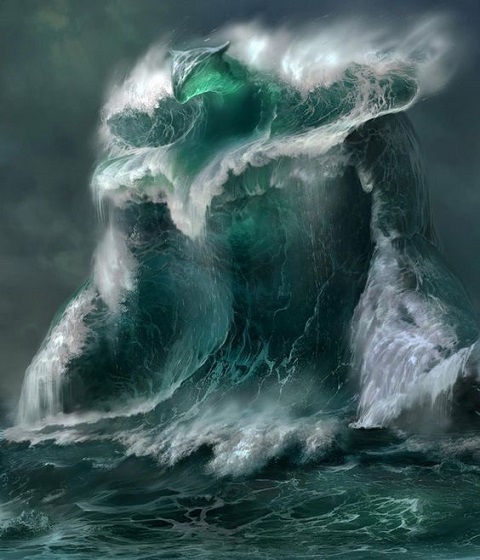
Guirfeint Water Elemental Warden
In the Second Epoch, the course of the river Guirfeint was changed from a southerly route through Kizan to a southeasterly one taking it away from the valley. This new course took it east of the Gakhs and down to Lethiel. The river's course change did not come about naturally. The Rúmil Nénharma changed the course of the river to cut off Rumaktharga's main water supply. The dwarves of this city also worked while the elves undertook the monumental feat of building a canal to re-route a river. While the elves were cutting a canal across the south of their city Idril Séregon, Rumaktharga was digging wells deep beneath the city and redirecting streams and making canals to re-route mountain streams in the direction of their valley redoubt.

Rúmil's workers used the flow of the river to help blast out the canal that would become its riverbed. They also employed earth elementals which were supplied by Geb's Chosen. Initially, the Angrods were against their neighbor's massive military project (as part of the First Kizan War). They seemed to have been convinced of its value after seeing that it stood a good chance of driving Rumaktharga's dwarves back to the Clans and that it would become the new territorial boundary (in their favor) with Rúmil. Construction of the canal through the hard rock of the Gakhs was aided by both magic like Dig and Move Earth spells and with the elementals supplied by Geb's proselytizers. The re-routing of a river and use of earth elementals to tear apart the earth and stone did not go over well with one of Silvanus's cults. After some intelligence gathering Cheldremn's spies learned of an enemy and potential ally in Karnegmoth. Cheldremn turned to the Greenland Alliance for help. The aid they got was a supply of water elementals and water weirds to ward the river once it joined with lake Lethiel. These watery creatures were assigned the task of hunting down any earth elementals or Geb's Chosen that remained in the area after the canal was built. Since Geb's Chosen still has a presence in Taurelin, these water elementals and water weirds still carry out their assignment. Some of them are also employed in guarding the pearl halls of Anglor Hellion. This place serves as the church of Lokestant, built while Geb's Chosen were helping the Rúmil re-route Guirfeint.